Energize

https://transporter.wilcoxfamily.net

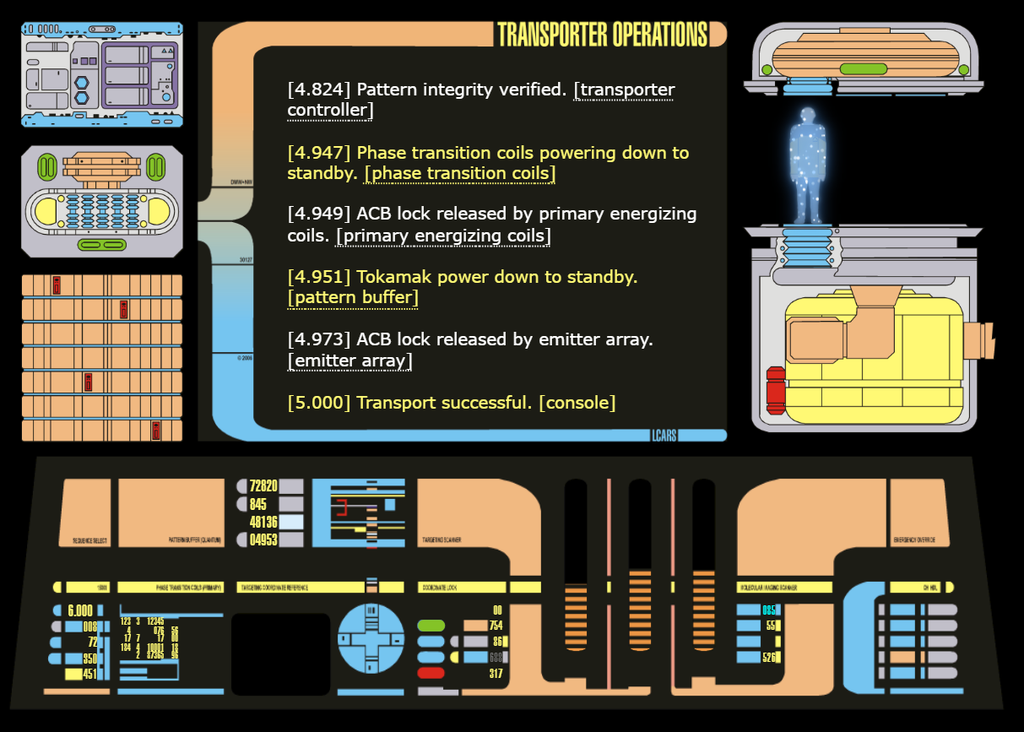
I wrote this for a final presentation in 2006 for Boston University’s MET CS 770: Object Oriented Analysis and Design class, under professor Suresh Kalathur. The objective was to model a “real world” system in software.

Deciding what to model was a challenge. An elevator system was tempting. And then, based on my nearly-compulsive reading of the Star Trek: The Next Generation Technical Manual by Michael Okuda and Rick Sternbach, I realized Star Trek’s transporter system would be ideal. I was still thinking about how to demonstrate the model, when my coworker Ravi Gopalan suggested I look at Adobe Flex.

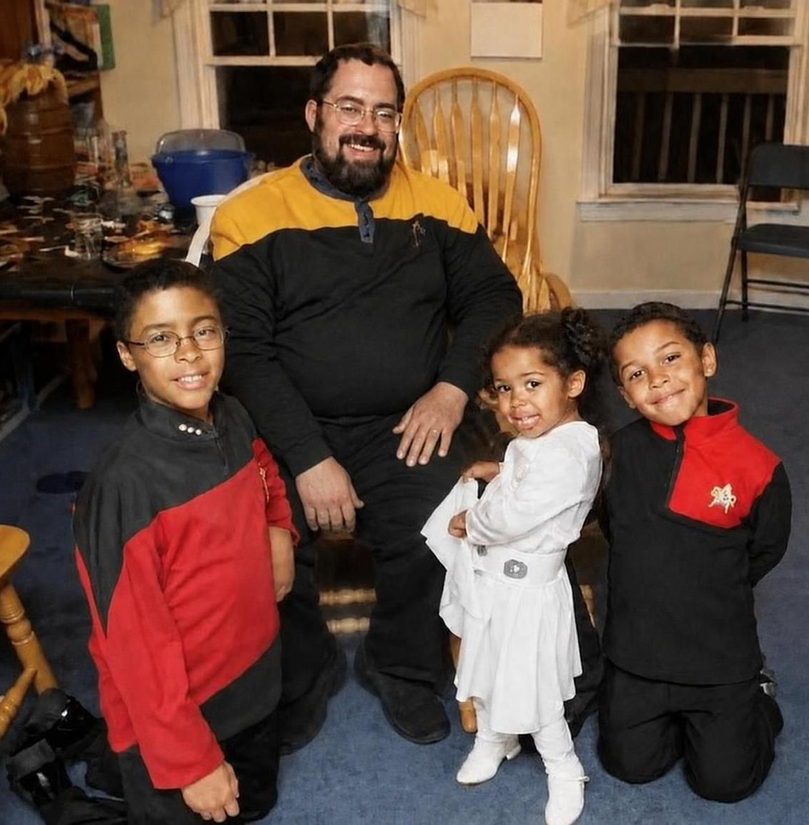
I was nearly instantly hooked with what Flex could do, running inside the Flash Player (the very thing that would doom Flex not many years later). With it, I could create a beautiful, interactive display that would have been painful (but not entirely impossible) to create in the Web browsers of 2006. I sank 40 hours (5 to 10 times what was needed) into the project, and even had my kids, dressed in Star Trek uniforms, enter the room at the end of my presentation saying I had beamed them into the wrong room.

And, for reasons that are fair and just, Flex died. No one wanted a horrifically insecure Web plugin, and browsers got truly standardized and more powerful. I kept my archive, and swore that someday I would get around to converting it to modern HTML5 or whatever was the standard when I did it.

Twenty years later (19 years, 51 weeks, and 1 day), I took a few minutes in a company-sponsored hackathon to have Claude Opus 5 do what I had never gotten around to. To my delight, with a tinge of horror, it took only minutes, most of which was spent on the Node build and testing, to get a perfect translation on the very first pass. I spent a few more hours tweaking, fixing some minor pre-existing bugs, and adding a few effects and features I had never gotten around to. (Software is never finished, just abandoned.)

Like Q at the end of “Deja Q,” (TNG s3:e13), “Heeeeeeeeeee’s back!”

—Doug Wilcox, November 2026 (Veracode Hackathon 28: Page Break)

Engage.
Dagnabbit. 1993 to 2026. No improvement.

They got me again. Despite my biological grandfather Ezra Rachlin’s well-established musical talent and perfect pitch, and my own children’s incredible musical abilities … Well, let me put it the way my son Isaac put it: “Let us take a moment to appreciate that Dad can communicate fluently in multiple languages, but cannot hum the Tetris theme.”

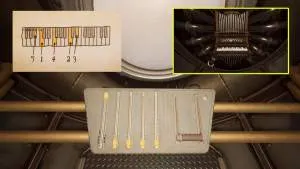
These two puzzles, the first image from the original Myst game, and the second from the Machinarium game require the same thing: Reproduce a series of notes from one place you hear them to another.

I know what to do, but I can’t “hear” it well enough to beat it. I think I’ve gotten the first four notes in Machinarium, but I’m not sure. I had to have my friend Eric Quinlan help me with Myst. Machinarium has 7 notes, but it should be easier, as there are only 5 keys, instead of the five notes and multiple slider positions in Myst.
A Conceptually Identical Puzzle from Machinarium.

:: sigh ::

Maybe tomorrow.

See less

Inspired Adventure!

We were on our way to visit family in Indiana when the surveillance gods1 of Facebook advertising noticed my location and fed me an picture from RoadSideAmerica.com that definitely had my interests dialed-in: Giant metal sculptures of Transformers and Star Wars vehicles (especially walkers) were free for the looking at the various locations of Metal Source, a metal processing/recycling company.

Some of the coolest sculptures were a little over an hour from where we were staying, in two locations in Wabash, Indiana. But our schedule with family visits was already pretty full. The one morning I had a bit of time available had been preceded by a very late night visiting a vernal pool under moonlight led by avid naturalist (and Sarah’s daughter) fern Wildtruth, which ended somewhere just before 3:00 am.

I nearly always choose adventure, but this time I contemplated skipping it. The schedule would be difficult, and I would need to be back with the car in time to visit Sarah’s father. But then I asked myself, “What would Dani do?” No, really. Dani is a coworker who works remotely and shares wonderful adventures as she travels all over for gigs as an itinerant cat-sitter.

So, I didn’t start quite as early as I expected, but figured that enough other people in the family would be sleeping in and otherwise slow-to-start, and I would have just enough time, even if I got nearly enough sleep. Several family members had claimed interest in coming with me, that is until morning actually arrived.

No matter. I got up quietly enough, and faster than you can say, “One very large coffee, please,” I was headed out to the Metal Source site with the most number of sculptures, an 1733 South Wabash Street in Wabash. If I had time, I would go to another site in Wabash that had a beautiful sculpture of Bumblebee from Transformers.

This was very much worth the trip. The main site has three Star Wars vehicles: An AT-AT, an AT-ST, and a speeder bike complete with a Scout Trooper. And there was a bonus Optimus Prime himself!

And this geek must pause a moment for deeply painful confession. I didn’t recognize Optimus. This sculpture was, of course, modeled after the film version of Optimus Prime, and my brain had long-ago solidified with Optimus looking like this:

But, I was too busy ogling the Star Wars vehicles to feel too much pain.

There’s even a metal sculpture of a fork lift, which was not quite as impressive as an AT-AT.

Realizing I had just enough time, I took off to the other side of Wabash.

At the 1750 Mill Street Metal Source location, there was only one sculpture, but it was a doozy. And, sadly for my Indiana and Duesenberg fans, the term doozy does not come from the car. (Please don’t tell my father-in-law.)

And I made it back before everyone had even finished their 1:00 pm breakfast.2

(If you’d like to see all the photos from these two Metal Source visits, here they are.)

  1. See The Age of Surveillance Capitalism: The Fight for a Human Future at the New Frontier of Power, by Shoshana Zuboff. This is a hugely important book, and you should read it. ↩︎
  2. Any differing version of this specific aspect of the story is an absolute lie. ↩︎

Éoywn is Remarkably Empathethic

Éowyn (our 3-year-old english cream golden retriever) surprises me with her empathy. (None of our other dogs had ever been remotely aware of emotional or physical pain or illness.)

I got home sick with a moderate fever, last week. Éowyn seemed to sense this, and immediately started licking me in the face, instead of excitedly expecting attention from me. When I lay down on the couch (okay, it’s a love seat, we’re short), she brought her big Lamb Chop over—not to play our usual evening game of “tug”—and carefully placed it on me, then lay down next to me. Not long after, she decided that I would be warmer with a dog on top of me. For the past 24 hours, she’s stayed right with me.

Update: I am feeling better, and Éowyn has returned to her usual behaviors. I must now play tug and “bite the hand” with her. She is back to her more typical self—now that I am.

English Spelling: Why It’s Such a Nightmare

Christopher Lloyd as The Calico Kid in Best of the West, 1981.

It’s funny what odd things one remembers. When I was 13, I liked a probably not-well-known, one-season comedy series called Best of the West. One of the few quotes I do remember was this conversation between The Calico Kid played by Christopher Lloyd and the town Doc Kullens played by Tom Ewell. I always remember it when thinking about language learning and how difficult English spelling must be to learn.

https://youtu.be/rtO6DuKfhIk?si=-C2ZMhISOVLgVqoy&t=967

Best of the West, Season 1 Episode 15: “The Calico Kid Goes to School”

Tom Ewell (Doc Kullens): Spell laugh.

Christopher Lloyd (The Calico Kid): Laugh. [spelling it out] L-A-L-F.

Tom Ewell (Doc Kullens): [Takes a long, slow drink from his hip flask] No.

Christopher Lloyd (The Calico Kid): How can that be? Calf is [spelling it out] C-A-L-F.

Tom Ewell (Doc Kullens): Yes.

Christopher Lloyd (The Calico Kid): Half is [spelling it out] H-A-L-F.

Tom Ewell (Doc Kullens): Yes.

Christopher Lloyd (The Calico Kid): Then laugh should be …

Christopher Lloyd (The Calico Kid): [interrupting; spelling it out] L-A-U-G-H.

Christopher Lloyd (The Calico Kid): No!

Tom Ewell (Doc Kullens): Yes.

Christopher Lloyd (The Calico Kid): Why?

Tom Ewell (Doc Kullens): Spite.

Haunting Reflections

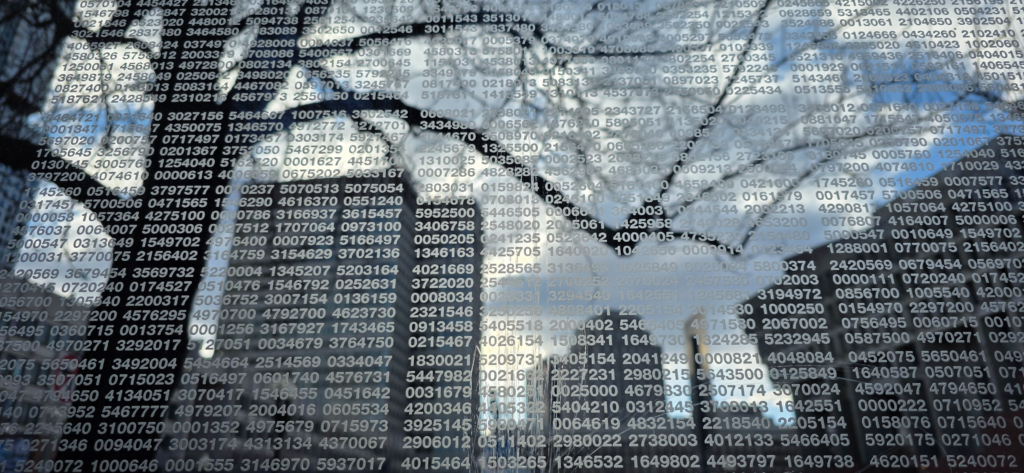
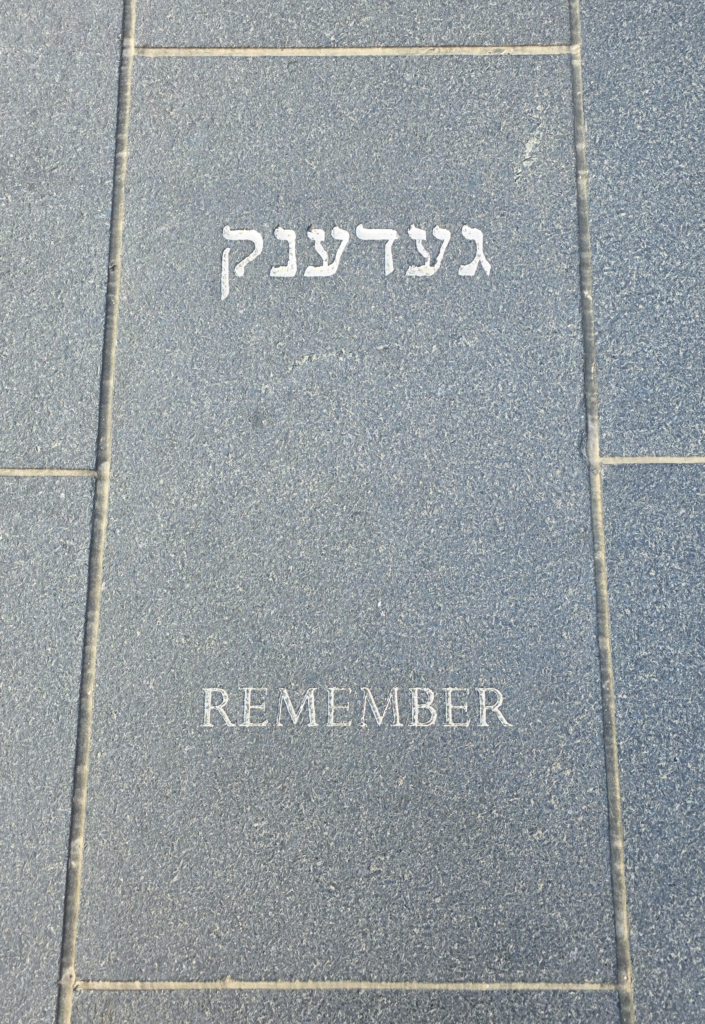
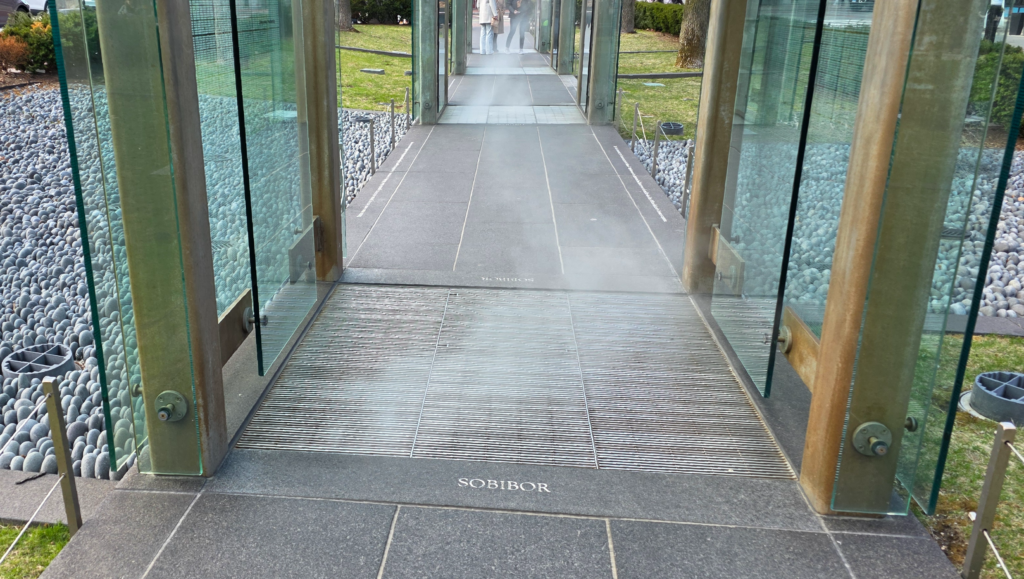
To remember their suffering is to recognize the danger and evil that are possible whenever one group persecutes another; … know that wherever prejudice, discrimination, or victimization are tolerated, evil like the Holocaust can happen again.

—New England Holocaust Memorial, Boston

I have been here to this memorial before, but today I wept as I walked through, thinking especially of my great-grandparents, Raphaël Alfandary and Léa Caraco.

They escaped Berlin for France soon after Kristallnacht, and remained mainly in hiding, first in Marseilles and then in Nice. Their last place of hiding was in Les Moussieres, in the Jura mountains in France, about an hour across the border from Geneva and the safety of Switzerland which they never reached.

Raphaël was tortured and later shot and killed by the Nazis (on April 12, 1944) while in hiding in France. Léa was transported to Auschwitz on May 20, 1944, and died during the death march out of Auschwitz in 1945.

Raphaël is buried in a mass grave in the municipal cemetery in Les Moussières (Jura), which bears the following epitaph:  « Aux Martyrs des Fournets 1944—Ici reposent les 6 Victimes Tuées aux Fournets le 12 avril 1944 par les barbares allemands et miliciens—Français Souvenez-vous » (“To the Martyrs of Les Fournets 1944—Here lie the 6 Victims Killed at Les Fournets on April 12, 1944 by German barbarians and militiamen – French, Remember.”)

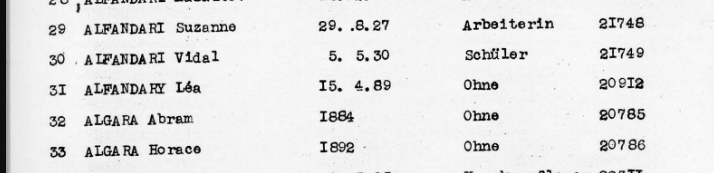
A transport record showing Lea Alfandary’s April 15, 1889, birthdate, her profession (“none”), and an ID number. 20912. This was Convoy number 74, destination Auschwitz. The data is from electronic data compiled by Georg Dreyfuss regarding deportees from France, based on Serge Klarsfeld’s “Le mémorial de la déportation des juifs de France” and other sources; data includes names, dates of birth and convoy, places of birth and convoy destinations, nationalities and convoy numbers.

Four Fathers

For Father’s Day, let me introduce you to four fathers I have had. The last one will blow you away. (And that’s not just clickbait.)

Here they are, in order of when I learned of them.

(1) Paul J. Wilcox, Jr. Pictured with my adoptive mother Addie is my adoptive father. I met him when I was 8 or 9 months old. Dad was supremely practical. For example, when I was born I was diagnosed as retarded. He declared, “Well, if he’s not going to work with his head, we will teach him to work with his hands,” and for Christmas after my second birthday I got a toolbox with real tools (the toolbox and some of the tools I still have). Dad, a lifelong refrigeration technician, was skilled at repairing everything except modern home refrigerators and cars, and could build just about anything. He taught me many skills that I still use today.

My Dad and Mom, Paul J. Wilcox, Jr., and Rachel “Addie” Wilcox

(2) R Michael Frenchman. Pictured with one of the most loving people I have ever met, his wife Karen Crowe, is Michael Frenchman. He was labeled my father by my biological mother, who misled people in that respect. We met when I was in my 20s. Michael is indeed a Renaissance man, doing everything from working with UN programs, to being an independent reporter in Iran, to mentoring high school students in videography and animation, to producing live theater and video projects. Getting to know him has been one of the delights of my life. (He even inspired me to get my SCUBA certification.) Michael, along with my biological mother, made the prudent decision to place me for adoption, knowing their own lives were too chaotic at the time to raise a child.

R. Michael Frenchman and Karen Crowe

(3) George Fortini, also pictured with my Mom. A few years after my Dad‘’’s death, Mom remarried George when she was 80 years old. The next few years were wonderfully happy for them, although Mom outlived him as well. George was crazily in love with my mother, and fit in well with the family. He wasn’t Dad, but pretty close, except with an even better sense of humor and cooking ability. Most important, he was wonderful for my Mom.

Rachel “Addie” Wilcox and George Fortini

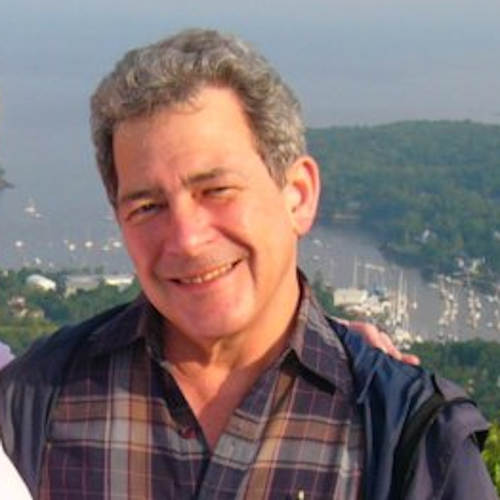
(4) Michael “Mickey” Rachlin. Well, this is the big surprise! After decades of searching, and over a decade of DNA sleuthing in search of my biological father, my cousin Audrey texted me last August and said, “I think I’ve cracked your case … but first, was there any reason you know of for your [biological] mother to have been in Texas?” I haven’t gotten to meet Mickey, as he passed away in July of 2020, before I was able to locate him. He never knew I existed, but, it is clear from other examples in his life that he would have loved to learn he had a son. He was the only child of Ezra Rachlin, who himself was a child prodigy pianist and conductor of, among others, the London Symphony Orchestra. I am still learning about Mickey through people in the family, but solving this mystery and expanding my known family has been huge, as you might imagine! I feel like I can only write in superlatives! I’m still learning what we had in common, but heard, from a stepsister, something I never was sure I would: “Oh my gosh, you look just like him!”

Michael “Mickey” Rachlin

It’s been quite a journey.

Fear

It is somewhere around 1:00 am. All but two of us are asleep.

I am hugging my daughter tightly as she sobs uncontrollably, her heart pounding with disappointment and fear.

There is nothing, really, I can say to comfort her. The best I can attempt is, “I will always fight for you,” as my own tears flow.

The Thoughts of One of Many

My name is David Isaiah Wilcox. I am black or African american or whatever you want to call me. I am also agoraphobic, but that will tie in later. I see all that is happening in the world, and I am hurt, not just because I am black but, because I am human. The blind eye that society has turned to the suffering of all those of different walks of life than the “majority” needs to stop. And it won’t be easy.

First I speak to those that are claiming to be ignorant of the atrocities of man, Then I speak to those that might hate or feel dirtied by my mere existence. First the virus known commonly as COVID-19 (called such because of the year it originated in)  Isolated us, forcing us to stay home or risk the lives of our loved ones that could be harmed or killed by the disease. Little did I know that twenty-twenty would be the year where another sickness would also be addressed, I of course speak of racism. It is odd for me to speak on this topic as I have been locked away in my home with little interaction with the outside world for much longer than the rest of you. I have been stuck at home for seven, coming on eight years now, due to a crippling anxiety disorder. I, when around people begin to ache through my whole body, this pain grows worse and worse until I just can’t take it anymore. In addition if I am outside too long I stop being able to think, and I do mean that in the most broad way possible.  If outside too long I begin to lose the ability to do simple tasks. Such as pace, five steps forward, turn, five steps back. On two occasions has it gotten this bad. Never again do I want to feel my brain turn against me to that extent.

I have strode a little off topic but I felt it was necessary to share what exactly I go through when I try to leave the boundaries of my home. Outside it seems the world has descended into chaos. When I heard what happened on May 25, 2020, I was appalled—sickened by what I was hearing. How could men, sworn to the protection of others, take the life of a man for the possibility that he paid with a counterfeit twenty dollar bill. For those that have not figured it out I am speaking of the murder of George Floyd. I found myself asking why aloud; I don’t know who I was talking to, perhaps God. Asking if all this is truly necessary, and if so to what end. Just end it already. I pleaded before and pleaded now “God, please end us all.” 

Racism is a disease, a plague that exists in the hearts of man, and can only be conquered if we as a whole acknowledge it, and strive to push past it.

Of course that would not work, we must rise above this adversity, this tragic condition that exists in far too many people. Racism is a disease, a plague that exists in the hearts of man, and can only be conquered if we as a whole acknowledge it, and strive to push past it. To make matters worse, we have a government that has decided that it is best to use rubber bullets, tear gas, and brute force to corral an unwarned and non-violent crowd of protesters. This reminds me of an event in our history, as a nation we once stood against tyranny, rallied together by the deaths of five and injuries of six. We were smaller then, and we had more problems, but how would we have responded had the very scared British Soldiers only used rubber bullets, avoiding the “Boston Massacre”? I guess we will never know. 

To close this session of writing, I should say there is hope. Not everyone is racist, for one reason or another. It doesn’t matter what pigment your skin is, if you notice you have a prejudice towards another, based on the pigment of their skin, stop, take a breath, and ask for help. It doesn’t matter who you ask, just talk about it, get it out in the open, and figure out where you picked it up from and how to get better from there. To those that deny that this is a rampant problem in our world, our lives, our souls, I ask you to look again, and ask someone about the pain that they have endured, just because they were born with a different amount of pigment in their skin.