Welcome to the Wilcox Family weB LOG, your source for the latest Wilcox news, anecdotes, and rants; and, as Jack Benny quipped on his first radio show (March 29, 1932), “There will be a slight pause while you say, ‘Who cares?’â€â€
Category: Significant
Our Most Significant Posts: If you read nothing else on our BLOG, read these.
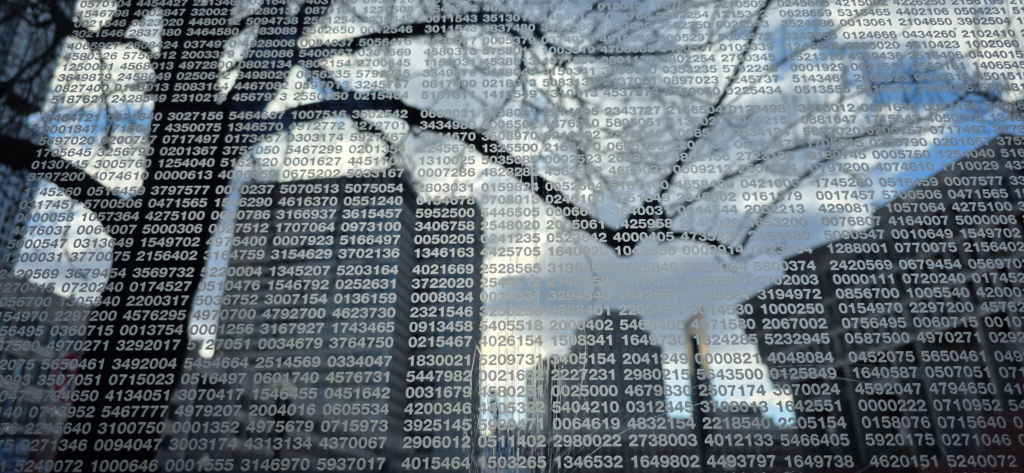
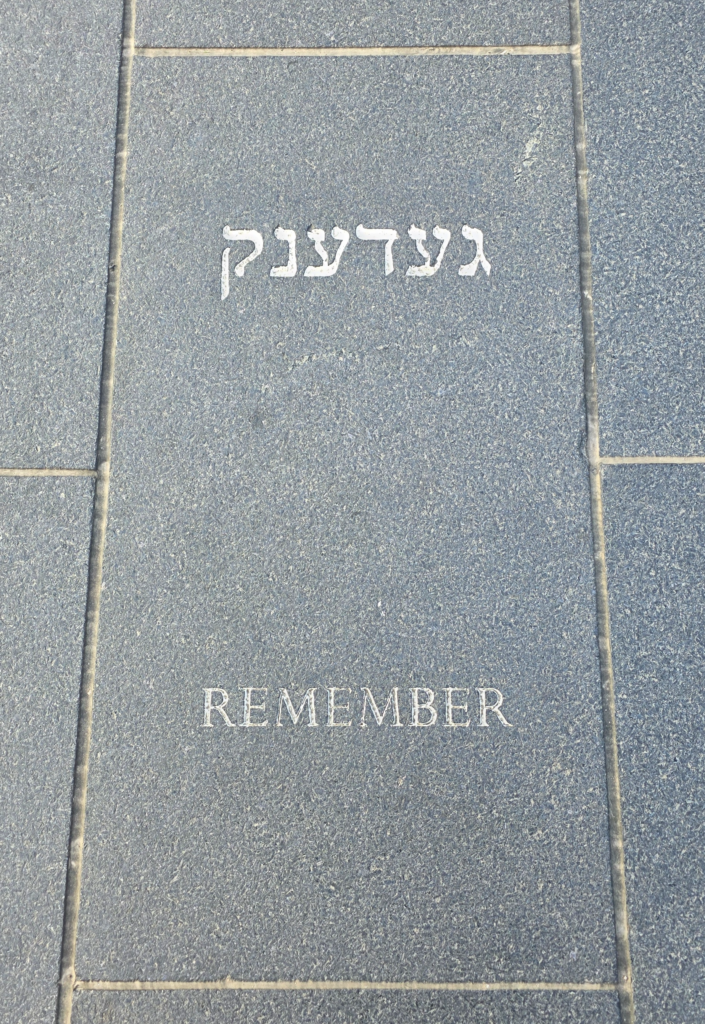
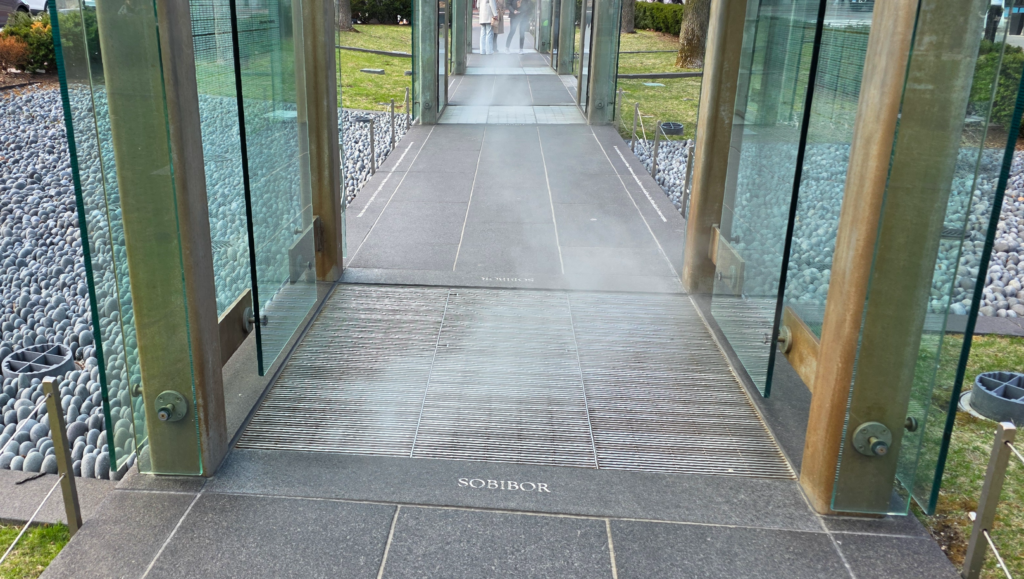
To remember their suffering is to recognize the danger and evil that are possible whenever one group persecutes another; … know that wherever prejudice, discrimination, or victimization are tolerated, evil like the Holocaust can happen again.
I have been here to this memorial before, but today I wept as I walked through, thinking especially of my great-grandparents, Raphaël Alfandary and Léa Caraco.
They escaped Berlin for France soon after Kristallnacht, and remained mainly in hiding, first in Marseilles and then in Nice. Their last place of hiding was in Les Moussieres, in the Jura mountains in France, about an hour across the border from Geneva and the safety of Switzerland which they never reached.
Raphaël is buried in a mass grave in the municipal cemetery in Les Moussières (Jura), which bears the following epitaph: « Aux Martyrs des Fournets 1944—Ici reposent les 6 Victimes Tuées aux Fournets le 12 avril 1944 par les barbares allemands et miliciens—Français Souvenez-vous » (“To the Martyrs of Les Fournets 1944—Here lie the 6 Victims Killed at Les Fournets on April 12, 1944 by German barbarians and militiamen – French, Remember.”)
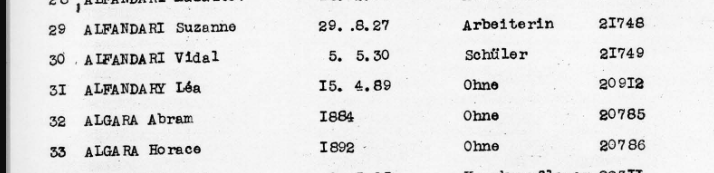
A transport record showing Lea Alfandary’s April 15, 1889, birthdate, her profession (“none”), and an ID number. 20912. This was Convoy number 74, destination Auschwitz. The data is from electronic data compiled by Georg Dreyfuss regarding deportees from France, based on Serge Klarsfeld’s “Le mémorial de la déportation des juifs de France” and other sources; data includes names, dates of birth and convoy, places of birth and convoy destinations, nationalities and convoy numbers.
For Father’s Day, let me introduce you to four fathers I have had. The last one will blow you away. (And that’s not just clickbait.)
Here they are, in order of when I learned of them.
(1)Paul J. Wilcox, Jr. Pictured with my adoptive mother Addie is my adoptive father. I met him when I was 8 or 9 months old. Dad was supremely practical. For example, when I was born I was diagnosed as retarded. He declared, “Well, if he’s not going to work with his head, we will teach him to work with his hands,” and for Christmas after my second birthday I got a toolbox with real tools (the toolbox and some of the tools I still have). Dad, a lifelong refrigeration technician, was skilled at repairing everything except modern home refrigerators and cars, and could build just about anything. He taught me many skills that I still use today.
My Dad and Mom, Paul J. Wilcox, Jr., and Rachel “Addie” Wilcox
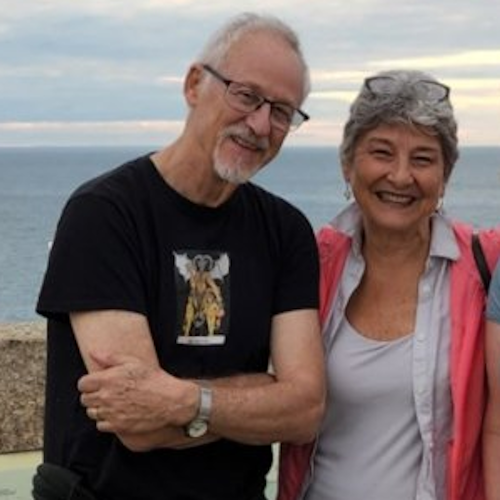
(2) R Michael Frenchman. Pictured with one of the most loving people I have ever met, his wife Karen Crowe, is Michael Frenchman. He was labeled my father by my biological mother, who misled people in that respect. We met when I was in my 20s. Michael is indeed a Renaissance man, doing everything from working with UN programs, to being an independent reporter in Iran, to mentoring high school students in videography and animation, to producing live theater and video projects. Getting to know him has been one of the delights of my life. (He even inspired me to get my SCUBA certification.) Michael, along with my biological mother, made the prudent decision to place me for adoption, knowing their own lives were too chaotic at the time to raise a child.
R. Michael Frenchman and Karen Crowe
(3) George Fortini, also pictured with my Mom. A few years after my Dad‘’’s death, Mom remarried George when she was 80 years old. The next few years were wonderfully happy for them, although Mom outlived him as well. George was crazily in love with my mother, and fit in well with the family. He wasn’t Dad, but pretty close, except with an even better sense of humor and cooking ability. Most important, he was wonderful for my Mom.
Rachel “Addie” Wilcox and George Fortini
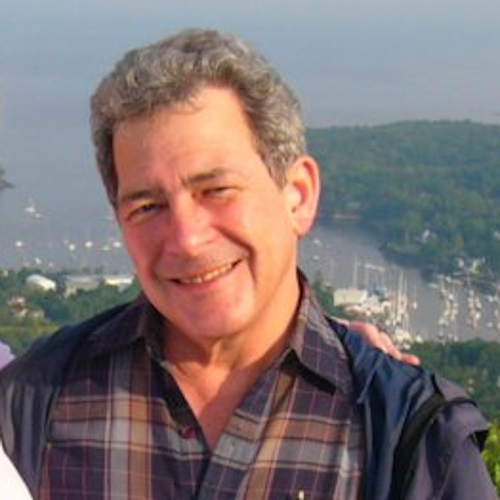
(4) Michael “Mickey” Rachlin. Well, this is the big surprise! After decades of searching, and over a decade of DNA sleuthing in search of my biological father, my cousin Audrey texted me last August and said, “I think I’ve cracked your case … but first, was there any reason you know of for your [biological] mother to have been in Texas?” I haven’t gotten to meet Mickey, as he passed away in July of 2020, before I was able to locate him. He never knew I existed, but, it is clear from other examples in his life that he would have loved to learn he had a son. He was the only child of Ezra Rachlin, who himself was a child prodigy pianist and conductor of, among others, the London Symphony Orchestra. I am still learning about Mickey through people in the family, but solving this mystery and expanding my known family has been huge, as you might imagine! I feel like I can only write in superlatives! I’m still learning what we had in common, but heard, from a stepsister, something I never was sure I would: “Oh my gosh, you look just like him!”
For the moment, there is far less chaos than a lifetime of apocalyptic and postapocalyptic fiction have led me to expect. This is a good thing. Sort of. I am disappointed that another trope has been shattered. No cities were surrounded by the military, sterilized with nuclear weapons, or set on fire.
It’s not all good, of course. There has been the inevitable dismissal of all we are doing to slow the spread of COVID-19, keep our health care systems from being overwhelmed, and save the lives of our seniors as nothing more than overreaction or a media frenzy. There was new terminology to learn, like presumptivepositive, which refers to a test sample that has tested positive by a state health service lab, but not yet been confirmed by the CDC itself. There was also the overlooked state of testing, which led to a false sense of security: Almost no one was being tested, even if they had been exposed to COVID-19 and exhibited every symptom perfectly, the lack of available test kits meant many such people were rejected from testing, and continue to be rejected even now. (I know it’s shocking and unprecedented, but President Trump is lyingto you.)
Oh, good. My slow-clap processor made it into this thing. So we have that. [H]ere’s a couple of facts: he’s not just a regular moron. He’s the product of the greatest minds of a generation working together with the express purpose of building the *dumbest* moron who ever lived. And *you* just put him in charge of the entire [country].
On Thursday evening we got ready to hunker down. Market basket, at the nearly-empty time Naomi and I normally go—Thursday evening at 8:00 pm—was Saturday-morning crowded. Toilet paper and bananas had disappeared. But the staffing had been ramped up, and people were amused and polite, as is typical for our neck of the woods. When I got home I ordered some devices to be used instead of toilet paper.
“For the love of God, Montresor!” This was the toilet paper aisle at Market Basket. The boxes contained Market Basket t-shirts. I think we were expected to take them as a consolation, although we did not.
Friday was a prearranged work-from-home day, while Veracode tested an “all-employees-working-from-home” scenario. There were few problems. On Sunday night, we received notice that mandatory working from home would be in effect for the next two weeks.
What do you do during a pandemic? Play Pandemic, of course. (We won on the very last turn possible.)
Humor is a typical fallback. I’ve remarked several times to David, whose severe anxiety keeps him inside at home almost all the time, “Look! We’re all David, now.” My kids have repeatedly quoted, “Oh, so now you’re interested in what introverts do for fun.”
Tonight we’re trying a long-distance game of Pandemic.
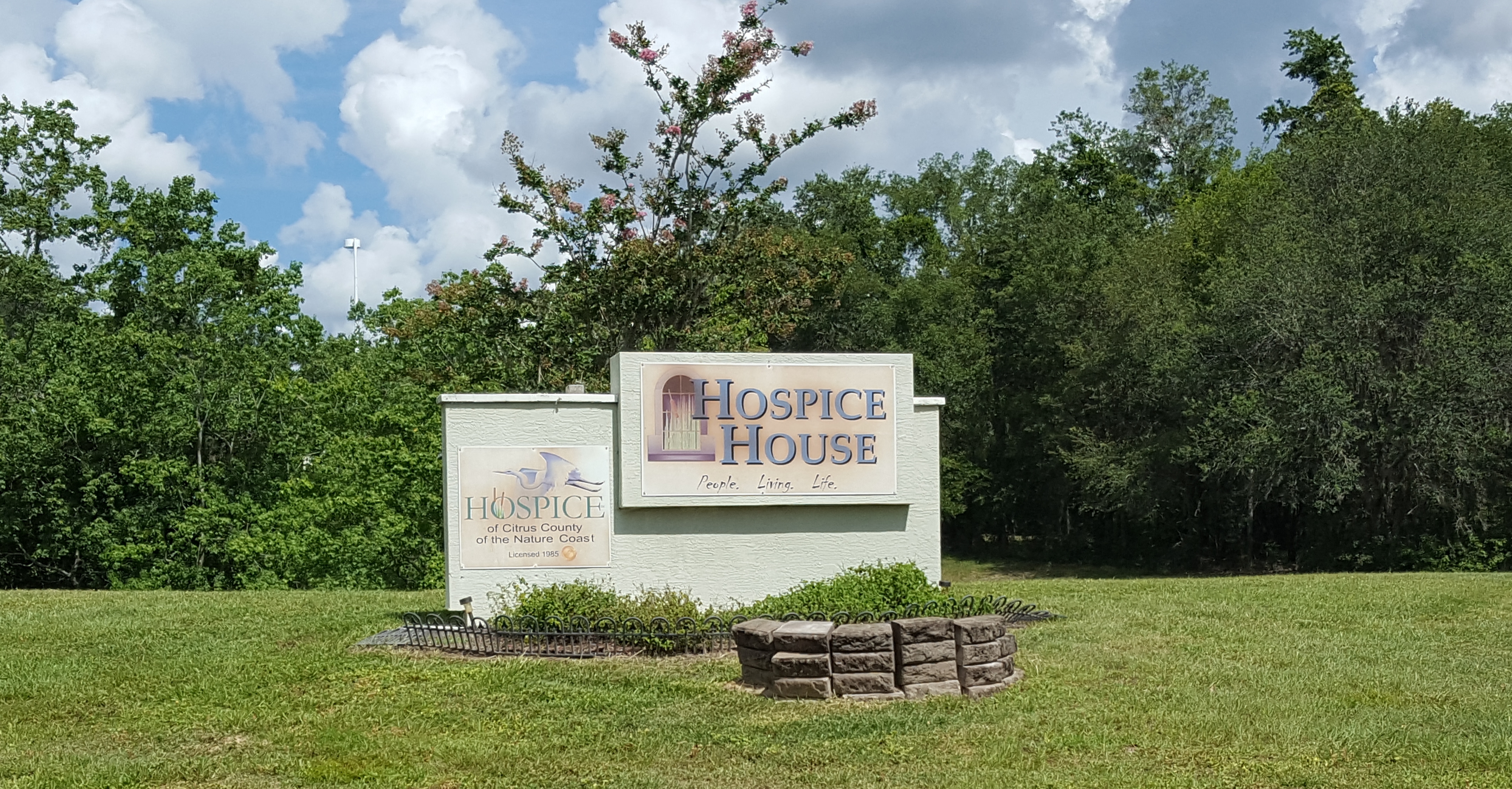
It is the 5th of July. Despite only a 3-hour flight, I’ve devoted most of the day to travel. Finally, after almost 12 hours of driving/waiting/flying/waiting/driving, I make it to Hospice House. Surprisingly, this is my first time visiting a hospice location. Although hospice was very helpful with my father’s last weeks, that situation was very different.
He will wipe away every tear from their eyes, and death shall be no more, neither shall there be mourning, nor crying, nor pain anymore, for the former things have passed away. (Revelation 21:4, ESV)
The lobby is beautiful. With fireplaces and chairs, it reminds me more of a relaxed hotel than a hospital setting. There is a tiny chapel off to one side, and a beautiful stone list of donors, decorated splendidly with a carving of a great blue heron in flight. But, I barely notice it.
I make my way, of course, to the wrong end of the hall. It is relatively late, although not at all dark, yet, and very quiet. When I get to the other end, I quietly inquire for my mother’s room number, describing the various ways she might be named. Addie Wilcox? Rachel Wilcox? Wilcox-Fortini? Mom’s legal name is Rachel Adeline Wilcox, but she never liked her first name, so she was Addie to nearly everyone.
Room 12. Give us a few minutes, we’re getting her cleaned up. So, I wait a few minutes for the nurses to finish. Finally, I get to see Mom.
“Oh!” she greets strongly, “My ugly son!”
“Ugly?” I exclaim in disbelief, “Compared to Paul or Aaron? I don’t think so!”
I last saw Mom in October, when Sarah and I had a long-weekend visit because, as Sarah insisted, “Your mother is not going to be alive forever. We should see her while she is well.”
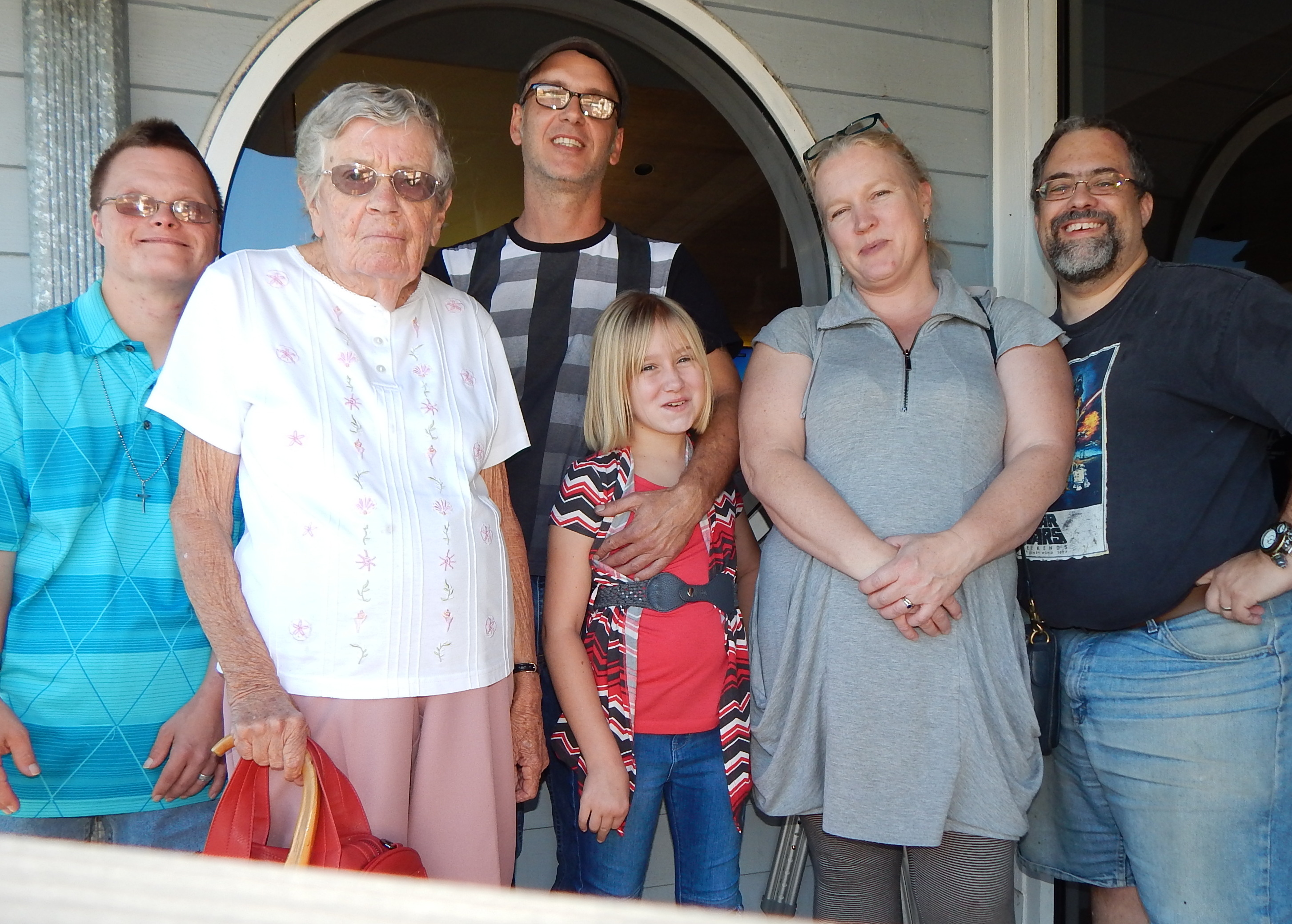
A motley crew at Charlie’s Fish House, October 2016. Yes, that is how my mother smiles, a genetic gift from her own father.
Now, not much later, Mom is markedly older. She looks tired. She is painfully thin, massing definitely under 45 kg. Her speech is slow, but clear. I also discover she can’t hear me unless I speak very loudly. She’s good at covering this, but her responses to questions she pretends to hear are often non sequiturs. (Later in my stay I will tackle this problem and diagnose a bad hearing aid, and come up with a good-enough-for-this-lifetime solution.) However, she is “all there.” Her mind and memory are, for the most part, intact. This is something of a disappointment to me, as I was hoping to be able to re-frame a few minor incidents from my childhood. This won’t be the case.
Mom watching a video of her favorite grandchild
I know, given the hour, that Mom will be tired, soon, so this visit will be short. There is one complaint Mom mentions at least once a day, and today is no exception: “I don’t know why the Lord still has me here, but He must have some purpose. I just wish I knew what it was.”
I understand her impatience to meet the Savior. She knows the time is soon. She is nearly 91. In less than a year, she has gone from driving interstate, living alone in her own home, and being in near perfect health, to having trouble walking, needing in-home care, and frequently visiting the hospital. The past two months have been particularly difficult.
My children often claim that Grandma will outlive them. This joke, which we have enjoyed for years, doesn’t seem as funny this week. I can’t keep a few lines from a song in The Muppets Take Manhattan, out of my head: “Saying goodbye, why is it sad? / Makes us remember the good times we’ve had.” The brain does strange things at times, as I will discover tomorrow.
I don’t know, of course, if this will be my last visit with this woman of many children: Four biological, three adopted, 87 (we think) fostered. I wonder if, sometime between my leaving this night and returning in the morning, my mother will go from seeing the object of her faith “in a mirror, dimly,” to “face to face.”
All too soon, Mom slips into a quiet sleep, and I drive the rest of the way to her house, navigating through tears, to where my sister Cindy is “holding down the fort,” as Mom would say.
Yes, we are of good courage, and we would rather be away from the body and at home with the Lord. (2 Corinthians 5:8, ESV)Â
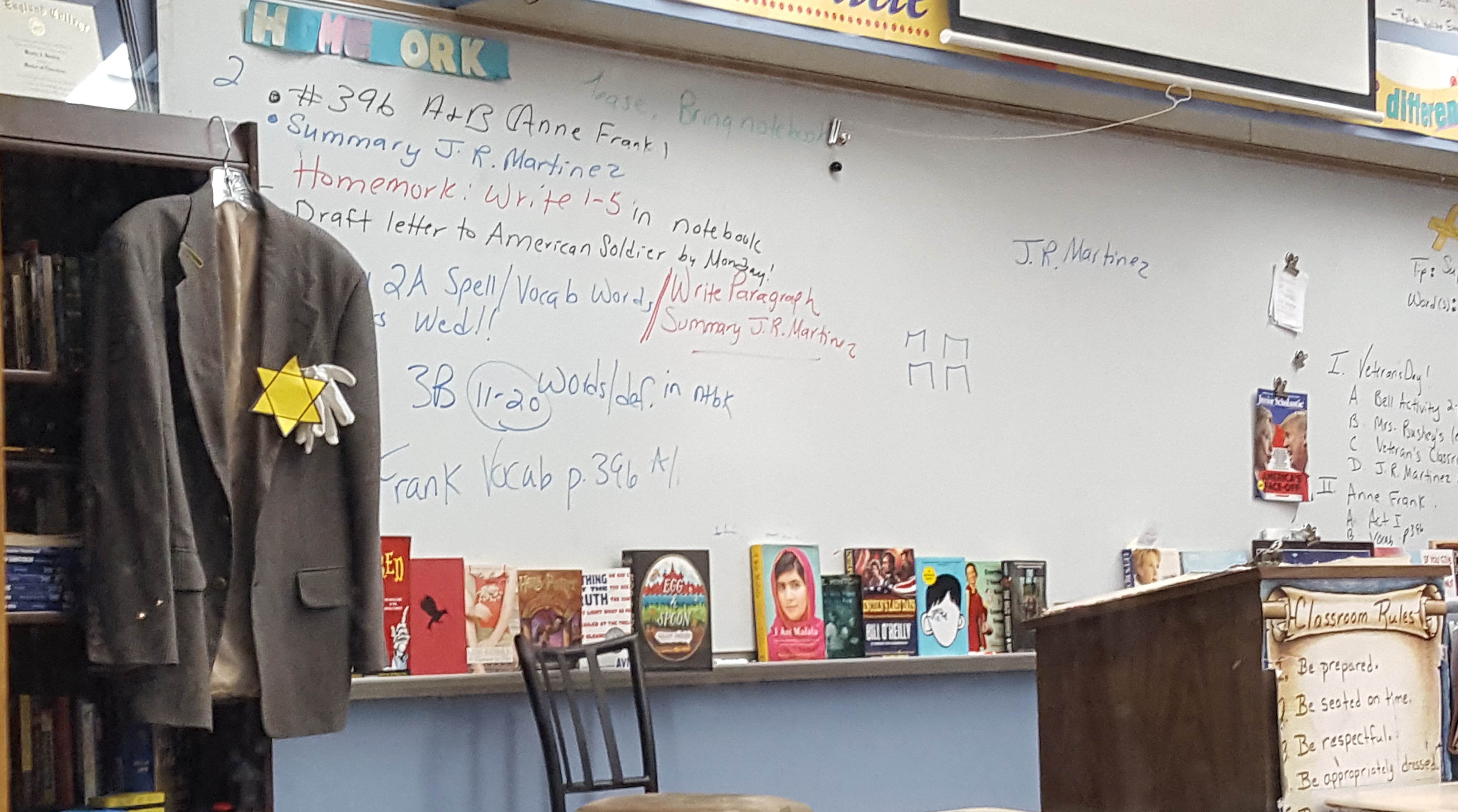
While my wife—Sarah Latimer—and I were walking our dog, Juno, we chanced upon an outside window of this history classroom at Nashua’s Fairgrounds Middle School, where our daughter, Naomi, attends.
I was moved to tears at the display, particularly given the anniversary of Kristallnacht. This was a meaningful reminder that, despite what we have seen all too often on social media and propaganda outlets, there are, indeed, those like this English teacher who are quietly and efficiently going about making the world a better place for all our children.
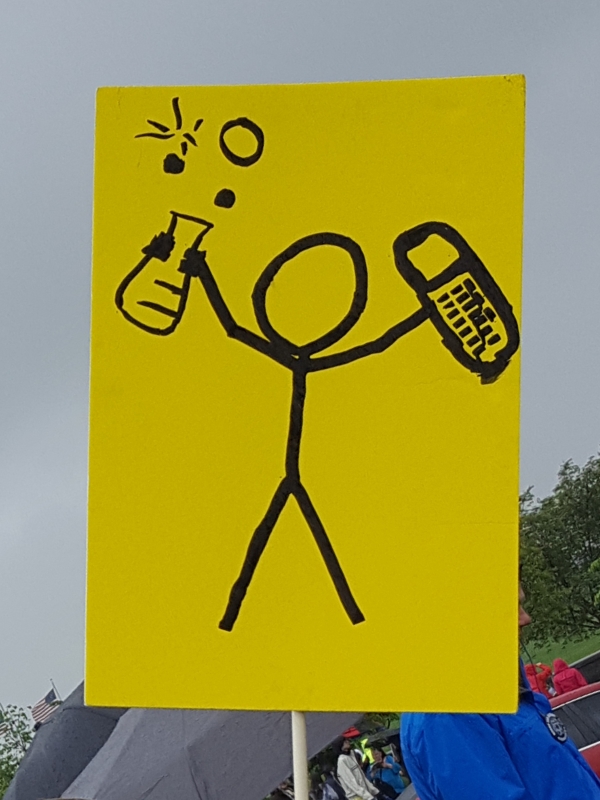
One of the best parts of the March for Science Sarah and I attended on April 22, 2017, in Washington, D.C., was the nearly endless creativity the marchers put into their signs. Not too many were repeated, and few would have been considered offensive. The preview image here is my sign, cribbed from “Stand back! I’m going to try science!” of XKCD origin.
All the signs we photographed:
[Best_Wordpress_Gallery id=”1″ gal_title=”Signs of Science”]
Originally published on September 11, 2003. Republishing for the 10th anniversary of this terrible, world-changing event.
Personal background: Michael Frenchman is my “not-father†(an interesting title that I coined with a history of accusation, assumption, adoption, and eventual DNA test), a dear-but-distant friend to our family, and a videographer/producer/diver/etc. He and his wife, Karen, reside on West 27th Street, in New York City. Coincidence brought him very close to the tragedy, and his well-written perspective goes well beyond the sound bites we (especially today) are accustomed to hearing from NYC residents.
From: Michael Frenchman Sent: Thursday, September 13, 2001 13:23 Subject: Where were you…
Sorry to have been out of touch in the last few days. We still can’t get long distance service and even email is sporadic.
Karen and I arose early on Tuesday morning, preparing to drive to the Staten Island car-ferry and another day working on our rental apartments there. We were running late and began to think we would miss the 8:45 boat. Our best route was straight down 7th Ave. to Vesey St. and then right a block to take the West Side Highway a few blocks further downtown to the ferry entrance at South Ferry. I suppose we turned onto Vesey Street at about 8:44 and onto the West Side Hwy at about 8:45. That corner is the northern base of the World Trade Center. We had the radio on. As we pulled into the ferry area, I heard one brief report that there had been an explosion at the WTC. Looking nearly straight up, we saw smoke and clouds of paper flying towards the east, to Brooklyn.
As soon as our car was loaded on board the ferry, we scrambled to the rear upper deck and watched in amazement as nasty gray-white smoke poured from the northwestern tower looming above us. Someone said they’d just heard that a twin-engine plane had hit the tower. Karen thought it might have been an accident—a small-plane pilot having a heart attack or some such and losing control. But I was convinced it was a deliberate act, by whom, I could only begin to guess.
A few other passengers joined us on that rear deck as the ferry pulled away from the terminal. The skies were crystal clear and blue. A foreign couple gazed in shocked amazement and tried to get a better look through the 25-cent binoculars. They offered us a peek. But the unaided view was clear enough from our close south side vantagepoint. We could see numerous plumes of smoke and tongues of flame pouring from broken out windows. We could not, of course, see the huge and gaping diagonal slash on the opposite north side of the building where the first plane had hit.
The ferry was perhaps a half-mile from the towers when we saw a silver and blue two-engine jetliner flying unusually low and slow up the harbor in-between us and the Statue of Liberty, passing less than a thousand feet to the west of our boat. People who often land at LaGuardia Airport know that the pilots frequently treat the passengers to a run up the Hudson River for a spectacular view of the city. The sentence was only half formed in my mind that the pilot of this jet must have been trying to see and show what was going on at the Trade Center when the actual trajectory of his course became frighteningly clear. As the plane banked slightly to its right, I said aloud “He’s going to hit it!” We stood fixed in horror for the 5 to 10 seconds it took for my prediction to be realized. Set against a perfectly clear and blue sky, our reality transformed into a wide screen movie as each frame presented a new millisecond of action: the jet angling for its final alignment, the glide of the now-irrevocable projectile, the counterclockwise-tilted plane disappearing into the building, a fractional moment of black gashed wall instantanously billowing out one-two-three conjoined black and orange balls of fire and debris, the slap of thunder three or four seconds after the impact.
“We’re under attack,” I said twice.
We watched as long as we could from the open deck until two police officers on board ushered everyone inside, I don’t know why except for some irrational and false sense of control in the midst of the surreal. We watched through the windows as all the other passengers gathered, some crying, some staring in disbelief, some talking excitedly on cell phones, many still all but oblivious to the event and unwitting as to it’s meaning. Karen and I touched the arm of a nearly frantic woman crying on her cell phone as if she were in communication with someone in the doomed buildings. There was nothing for us to say or comprehend.
Once off the ferry, we drove half wild to our apartments and sat with one of our tenants to watch the terrible drama unfold on TV just like the rest of the world. We are now somewhat like those hundreds of people who were in Daley Plaza in Dallas and had a glimpse of the Kennedy motorcade and those awful moments and who then watched that eternal frame replayed and replayed for the past forty years. Our actual memory: the sights, the unwarned, unformed reactions, the smells of the harbor, the brush of the breeze, the heat of the early morning sun, the murmur of the other passengers, the rumble of the ferry engines, the hand of Karen in mine, the raw surprise as the world tipped on a new and unexpected pathway. All this will now blend and merge into the TV images of others’ amateur video, of traffic-helicopter cameras and sky cams on network TV buildings uptown.
I remember that in the plaza in front of where the towers stood was/is a sculpture depicting two pyramids—an allusion to the notion that these structures would last as long as their antecedents at Giza. Like you, we watched them melt to the ground and blow like so much desert dust.
So that is where I was and what I saw on one of those days which we will all always remember. “Where were you when ….?”
Karen and I spent the rest of Tuesday alternating between the TV and our chores at the apartment. What else could we do? We spent the night with friends on Staten Island, obviously unable to return to a besieged and cut-off Manhattan.
By late afternoon yesterday (Weds.), enough access had opened into the City that we were able to wend our way across the Verrazano Bridge, up the Brooklyn-Queens Expressway, past the prohibited Brooklyn, Manhattan and Williamsburg bridge entrances, onto the Long Island Expressway, past the “show your driver’s license” check point at the Midtown Tunnel and back into a quiet and subdued city. We have traveled a lot this summer. No time away has seemed as long as these 36 hours.
Thanks to everyone who called to see how we were. We were never in any real danger except during the moments we were driving below the base of the now-disappeared twin towers. We’ll never know what flaming debris may have fallen to the street yards behind our passing car. But our personal story is so many orders of magnitude less significant than that of the thousands dead and injured and directly traumatized and so picayune compared to the onrushing and unpredictable consequences of this ugly act that I even hesitate to retell it.
We hope you are all well and that some good ultimately comes out of this tragedy.
But on the first day of the week, at early dawn, they went to the tomb, taking the spices they had prepared. And they found the stone rolled away from the tomb, but when they went in they did not find the body of the Lord Jesus.
The Garden Tomb, now empty.
While they were perplexed about this, behold, two men stood by them in dazzling apparel. And as they were frightened and bowed their faces to the ground, the men said to them, “Why do you seek the living among the dead? He is not here, but has risen. Remember how he told you, while he was still in Galilee, that the Son of Man must be delivered into the hands of sinful men and be crucified and on the third day rise.”
… was the text message I received recently from a heartbroken friend. I am not at liberty to share the details behind this, but emotional abuse figured significantly in the story that was summed up by that statement.
For several years, I have informally studied the short- and long-term effects of sexual abuse. I have read over a dozen books on the topic, attended trials and hearings, evaluated cases in the media, communicated with subject matter experts, and supported and interviewed survivors. The bottom line is, as Anna Salter wrote, “Child sexual abuse was like getting bitten by a rattlesnake: Some kids recovered completely, and some didn’t, but it wasn’t good for anybody.”
On the whole—unlike 20 years ago—our society is beginning to “get it” in regard to sexual abuse. Popular knowledge is now cognizant of the need to expose its occurrences, protect its survivors, and punish and forever monitor the offenders.
Sadly, the balance still favors the offender. Most are never caught; even those who are prosecuted often reach that stage only after permanently damaging numerous innocents. The jerks always win.
But there is another type of abuse, typically (but not exclusively) perpetrated by males against females, that we often gloss over: Verbal and emotional abuse.
There was a lot I did not understand about sexual abuse, due to my own ignorance—I could not fathom, for example, why Celie did not simply run away to escape her abusive husband when I read The Color Purple ages ago. Of course, now I know that her sexual abuse as a child played a large part in this, and that certain types of abusive behavior will nearly always produce certain types of behavioral results, such as remaining with or returning to the abuser. Whether this can be explained rationally is irrelevant; the causative facts remain both evident and consistent.
There is a lot I do not understand about verbal or emotional abuse. Why would one continually mistreat a woman with whom he shares a social or even romantic connection? Why would anyone continually belittle her accomplishments, describe her as worthless or stupid, scream profanities at her, become angry at her without provocation, or limit her financial and personal freedom?
Why take something beautiful and damage it, making it less valuable?
Why tarnish God’s most beautiful and intricate creation, rather than polishing it for all the world to see?
We’d like to think this happens only in our underclasses, but that is hardly the case. One account conveyed to me by a friend was of a woman who was a published biological research scientist, with a doctorate. This didn’t protect her from her boyfriend whose constant belittlement convinced her that she was of no value. This happens far more than we realize.
I confess, I simply do not understand verbal or emotional abuse. I absolutely cannot understand why someone would mistreat any woman, especially one entrusted into one’s care. I know what the advice is to those in an abusive situation: “Get out immediately”; but few will be able to heed that. I often wonder why women seem to be so predictably malleable under such abuse, but perhaps this is why the Apostle Peter referred to wives as “the weaker vessel,” and commanded husbands to honor them and be understanding.
I see that I need to improve my knowledge deficit, just as I studied sexual abuse.
In the case of Muslims, this means selecting verses which support terrorism and destruction of all infidels. By basing the arguments upon the Islamic scripture of the Qur’an, rather than merely intellectual or emotional basis, Hassan Butt was able to convert those who were Muslim political activists to a more violent agenda. I’ve transcribed portions of his interview below. (Please pardon my uneducated transcription of the Arabic words used.)
[Renee Montagne (Interviewer )] You recruited others. What did you tell those that you were talking to that they found the most compelling?
[Hassan Butt] Obviously we would talk about the atrocities that were taking place in Palestine, in Iraq; the atrocities that were being comitted by Muslim governments with the support or with the silence i guess of the Western regimes. And these would be inspiring factors, but this wouldn’t be the thing that would turn someone from a normal political activist to someone who would turn to militant radical Islam. It became us teaching these people that the only solution Islamically that we have is to fight these people and to kill these people. We would use islamic theology, and we would show them that the work we were engaging in was an obligation upon Muslims, using various interpretations of the Qur’an and various interpretations of the saying of the prophet Mohammed.
There’s a verse in the Qur’an which means “strike fear in the hearts of the unbelievers.” We would actually say terrorism is part of Islam. It’s not something against Islam. This word is actually used in the Qur’an. It comes from the word il-hab.
Eventually, Mr. Butt left radical Islam, and currently works to combat it. His impetus for leaving seems to have been the same kind of unanswered questions which often interest young Muslims in radicalism:
I really began to think, “Is this really being done in the name of Islam or is this being done in the name of some political agenda?” For me these people became murderers who just enjoyed killing and causing havoc, rather than trying to achieve any type of stability as a result of it.
He goes on to discuss how the intentional disregard of certain portions of the Qur’an, on both sides of Islam, allows Islamic terrorism to prosper:
For a long time, a lot of people, especially the moderate Muslims have been talking about how peaceful Islam is and how loving Islam is, and what they’ve tended to do is ignore the verses and chapters in the Qu’ran that talk about violence, that talk about killing, and they’ve hoped by ignoring it, or being in denial about it, that this problem would disappear, and this hasn’t been the actual case. If I’m a young Muslim who’s picked up the Qur’an and come across certain chapters and in there it says, “Kill the unbelievers until they become Muslim; fight them until they say, ‘lahi lahi l’allah.'” [I believe this is, “There is no God but Allah.”] You know, if a young Muslim reads that, and he goes to the mosque and the mosque says, “Oh, don’t ask questions like this,” or the moderate Muslim says, “Oh, don’t discuss things like this,” if they then go to the radical Muslim who is willing to discuss this Qur’anic chapter, then naturally he’s going to become inclined towards him, because this person is giving him answers to questions that his mind has. And so hence what I’m calling for is there to be an open debate, firstly. We need to be able to go back to the books of Islam and to be able to a new what we call itchthihad, or like create a new reality and explain, “Hang on a second, you know, everything that was written in the Medieval times is not applicable today,” and then that new reality needs to be addressed to young Muslims.
One of the things that’s fascinating about this interview is the idea presented that both the extremists and the moderates have the same flaw in ignoring part of the Qur’an, which ultimately serves the radicals.